What words per hour actually measures
Words per hour is simply how many words you produce in an hour of actual writing. The math is easy: words divided by time in hours. Write 750 words in 45 minutes and you wrote at 1,000 words per hour, because 750 divided by 0.75 hours is 1,000. The reason it beats raw daily word count is that it accounts for the time you spent. A 500-word day in twenty minutes and a 500-word day in three hours are very different facts about your writing, and only pace tells them apart.
What a realistic pace looks like
There is no universal target, and chasing someone else's is a trap. For first-draft fiction, many writers settle around 500 to 1,000 words in a focused hour once they know the scene they are writing. Fast-drafters push higher; careful, research-heavy, or technical writing runs slower, and all of that is fine. Drafting is faster than editing, a known scene is faster than a blank one, and everyone is slower in the first ten minutes. For how this scales up to a whole book, see how long it takes to write a novel, and for what working authors actually produce, the daily word counts of professional authors.
| Words per hour | One focused hour | An 80,000-word draft at 1 hour a day |
|---|---|---|
| 500 | 500 words | about 160 writing days |
| 750 | 750 words | about 107 writing days |
| 1,000 | 1,000 words | about 80 writing days |
| 1,500 | 1,500 words | about 54 writing days |
Those are writing days, not calendar days. Miss a couple each week and the real finish stretches to match, which is exactly why planning from your honest average beats planning from your best-ever day.
How to measure it without a stopwatch
You can do it by hand: note the time you start and stop, count the words, divide. The problem is that nobody keeps that up for long, and a single session is noisy anyway. What you want is the average across many sessions, which is exactly the kind of thing a tracker should handle for you.
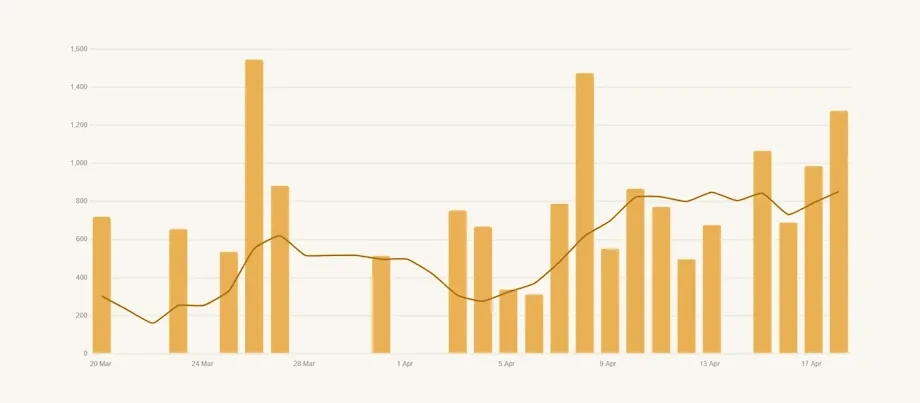
In Authorlytica, you log a session with its duration and the words you wrote, and your words per hour is worked out automatically. Over time it rolls into your rolling averages and feeds the Speed dimension of your Writer Profile, so you see a stable, real pace rather than the swing of any one day. If you just want a one-off estimate from a goal and a deadline, the Word Goal Calculator does that side of the math.
The useful part: planning, not racing
Once you know your honest pace, the planning follows directly. Say you average 800 words an hour and can protect one hour most days. That is roughly 800 words a day, which puts an 80,000-word novel a touch under four months of drafting away, before life interrupts. Now your finish date is grounded in a real number instead of optimism. That is the whole reason a tracker can project a finish date: it has your actual pace to work from.
The short version
Words per hour is the bridge between a wish and a schedule. Measure it across many sessions, not one, let a tracker keep the average, and use it to set a finish date you can actually believe. Then leave the number alone.